| Real Estate Q&A: How the Self-Employed Can Get a Mortgage |
| By Gary M. Singer |
| RISMEDIA, Saturday, December 14, 2013— (MCT)—Question: I am self-employed and make a good living. I want to buy a house, but it’s hard to document my income. So I’ve been getting turned down for a mortgage, even though I’m willing to make a large down payment. Any hope for me? —Trevor Answer: With banks and the federal government tightening lending requirements, it has become increasingly difficult for people who don’t get regular paychecks to qualify for loans. Although still rare, “stated income” loans are making a comeback. But they require very high credit scores, large down payments and deep cash reserves. If this is not available, you will have to try to get a loan based on your tax returns. Still, this can be difficult because the self-employed tend to use expenses to offset their net income, resulting in low numbers. That forces them to choose between favorable tax treatment or getting a loan. If you can’t find a loan from a traditional bank, there are a growing number of private lenders. Some, such as “hard money” lenders, will offer a smaller amount based only on the value of the house, perhaps lending 50 percent of its value. Others also will look at your credit, income and debts and lend larger amounts. Because these kinds of loans are risky for the lender, be prepared to pay a higher interest rate and higher closing costs. Shopping around is especially important with these loans because the costs and rates vary greatly from one lender to another. Gary M. Singer is a Florida attorney and board-certified as an expert in real estate law by the Florida Bar. ©2013 Sun Sentinel (Fort Lauderdale, Fla.) Distributed by MCT Information Services
RISMedia welcomes your questions and comments. Send your e-mail to: realestatemagazinefeedback@rismedia.com.
A. Joseph Marshall Coldwell Banker Commercial Commercial Real Estate Advisor Savannah, Ga 912-790-6999 |
Monday, December 16, 2013
Real Estate Q&A: How the Self-Employed Can Get a Mortgage


Wednesday, September 25, 2013
Coastal Empire Economic Index Q2 2013


A. Joseph Marshall
Coldwell Banker Commercial
Commercial Real Estate Advisor
Savannah, Ga
912-790-6999
Friday, August 16, 2013
What homeowners need to know about avoiding foreclosure
I am reposting this article word for word that I got from Steve Nimmer here at Coldwell Banker Mortgage. (912) 604-3834 NMLS #: 186680.
Even though the recovery is over and people are getting rich in real estate(Flip That House Now! radio ads are playing again) there are plenty ofhome owners bank borrowers that are still struggling. And for some reason I sense there is a kind of stigma against them now that it is common knowledge that the recession is over.
So, here is Steve's article to help you out.
Since September 2008, the industry has seen some 4.5 million foreclosures completed, according to the June 2013 CoreLogic® National Foreclosure Report. And while those numbers have been coming down, it is still important that borrowers and homeowners understand what they can do to prevent foreclosure.
That means taking action at the first sign of trouble, such as the first time a homeowner makes a late payment or misses a payment altogether.
1. Analyze the cause
Was the payment late because the borrower had an unexpected expense, like a car repair or a medical bill? Or is the problem due to a job loss, disability or serious illness that could affect income for an indefinite period of time? The answers to these questions can help determine the best next steps.
2. Understand the foreclosure timeline
For most mortgages, a payment made one to 14 days late falls within a grace period. Payments 15 to 30 days late incur a late fee, which must be included at the time of payment. After 30 days, missed payments impact the borrower's credit score. Foreclosure procedures usually begin after four missed payments.
3. Optimize cash flow
Regardless of the scenario, it may be helpful for borrowers to revisit their budget and consider trimming extras like eating out, entertainment and other discretionary spending. It may also be necessary to generate additional income through part-time work or a second job.
4. Make a full payment – including late fees
A partial payment is usually credited as a principal reduction, not a regular mortgage payment. It's better to make a full payment, including any late fees, as soon as the money is available.
5. Communicate with their lender
The lender can help determine whether the borrower is eligible for any of several alternatives to foreclosure, such as refinancing or loan modifications. Even if the mortgage amount is more than the home is worth, the lender may be willing to accept a short sale or a deed-in-lieu of foreclosure.
The bottom line
A willingness to step back and assess the financial situation, take positive action to address shortfalls and work with the lender can go a long way toward helping borrowers avoid becoming foreclosure statistics.
Sources:
CoreLogic® National Foreclosure Report, June 2013
Freddie Mac: Alternatives to Foreclosure
7 Steps to Avoid Foreclosure by Tara-Nicholle Nelson, Esq.
A. Joseph Marshall
Coldwell Banker Commercial
Commercial Real Estate Advisor
Savannah, Ga
912-790-6999
Even though the recovery is over and people are getting rich in real estate(Flip That House Now! radio ads are playing again) there are plenty of
So, here is Steve's article to help you out.
Since September 2008, the industry has seen some 4.5 million foreclosures completed, according to the June 2013 CoreLogic® National Foreclosure Report. And while those numbers have been coming down, it is still important that borrowers and homeowners understand what they can do to prevent foreclosure.
That means taking action at the first sign of trouble, such as the first time a homeowner makes a late payment or misses a payment altogether.
1. Analyze the cause
Was the payment late because the borrower had an unexpected expense, like a car repair or a medical bill? Or is the problem due to a job loss, disability or serious illness that could affect income for an indefinite period of time? The answers to these questions can help determine the best next steps.
2. Understand the foreclosure timeline
For most mortgages, a payment made one to 14 days late falls within a grace period. Payments 15 to 30 days late incur a late fee, which must be included at the time of payment. After 30 days, missed payments impact the borrower's credit score. Foreclosure procedures usually begin after four missed payments.
3. Optimize cash flow
Regardless of the scenario, it may be helpful for borrowers to revisit their budget and consider trimming extras like eating out, entertainment and other discretionary spending. It may also be necessary to generate additional income through part-time work or a second job.
4. Make a full payment – including late fees
A partial payment is usually credited as a principal reduction, not a regular mortgage payment. It's better to make a full payment, including any late fees, as soon as the money is available.
5. Communicate with their lender
The lender can help determine whether the borrower is eligible for any of several alternatives to foreclosure, such as refinancing or loan modifications. Even if the mortgage amount is more than the home is worth, the lender may be willing to accept a short sale or a deed-in-lieu of foreclosure.
The bottom line
A willingness to step back and assess the financial situation, take positive action to address shortfalls and work with the lender can go a long way toward helping borrowers avoid becoming foreclosure statistics.
Sources:
CoreLogic® National Foreclosure Report, June 2013
Freddie Mac: Alternatives to Foreclosure
7 Steps to Avoid Foreclosure by Tara-Nicholle Nelson, Esq.
A. Joseph Marshall
Coldwell Banker Commercial
Commercial Real Estate Advisor
Savannah, Ga
912-790-6999
Tuesday, June 18, 2013
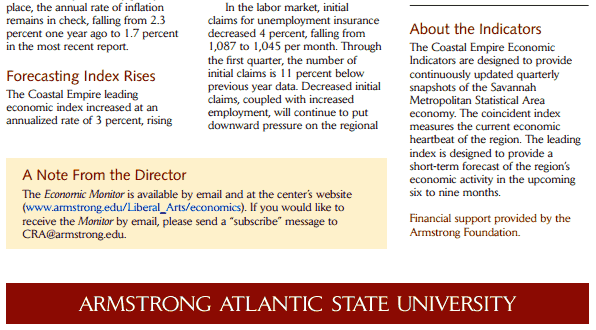
AASU Coastal Empire Economic Monitor Q1
Dr. Toma has published the 2013 Coastal Empire Economic Monitor Quarter 1 report.
Summary: We are treading water in a sluggish stream that is moving in the right direction. Consumer confidence is weak, but tourism is up and so is housing. (In fact, in many areas of Savannah we are in a seller's market!)
Click on the images for enlargement.


Summary: We are treading water in a sluggish stream that is moving in the right direction. Consumer confidence is weak, but tourism is up and so is housing. (In fact, in many areas of Savannah we are in a seller's market!)
Click on the images for enlargement.


Saturday, May 18, 2013
Roubini Gets It If Only Everyone Else Did
Friday, April 26, 2013
Tampa Luxury Retail Market Report

A. Joseph Marshall
Coldwell Banker Commercial
Commercial Real Estate Advisor
Savannah, Ga
912-790-6999
Thursday, April 25, 2013
Healthcare Real Estate: Looking Beyond The Indicators
I don't know who is reading this blog in India, but thank you very much! If you've got investors in Pune who in interested in property over here, give me a call.
Healthcare Real Estate: Looking Beyond The Indicators is such a good article that I am posted some of it here. It was published 10 days ago by Wayne Grohl for The Source blog.
On a side note, my colleague Linda agrees with the conference's tone. This field is growing steadily, but now cautiously. She works extensively in healthcare real estate and sold two hospital sites in the last two years. The third, which was to be a community hospital, was indefinitely delayed.
Healthcare Real Estate: Looking Beyond The Indicators is such a good article that I am posted some of it here. It was published 10 days ago by Wayne Grohl for The Source blog.
With only a few exceptions, the mood was decidedly up at Thursday’s Healthcare Real Estate Conference in Chicago. The investors, brokers, tenants, developers and managers who met at the University Club came to hear about strategies and trends in development, management and capital for medical properties ranging from medical office buildings (MOBs) to large healthcare campuses to retail outpatient facilities.
Superficially, the first indicator from 2012 was a drop in medical facility construction starts. Usually, when a sector sees a drop in national groundbreaking, it's kind of tough to read the tea leaves as anything other than a negative.
That wasn't the diagnosis at the conference.
On a panel including Shawn Janus of Jones Lang LaSalle's Healthcare practice, the drop in starts was likened to a deception associated with long-term factors finally clearing up. "We saw a decrease due to the capital markets still rebounding, and a SCOTUS ruling on ACA, then an election," said Janus. "With all that behind us we're going to see greater activity. On the acute care side, that has dropped off. Community hospital starts has slowed down. But we're going to see high-acuity activity driven into the outpatient environment.
On a side note, my colleague Linda agrees with the conference's tone. This field is growing steadily, but now cautiously. She works extensively in healthcare real estate and sold two hospital sites in the last two years. The third, which was to be a community hospital, was indefinitely delayed.
- Acute care: more or less means large hospitals.
- High acuity: medical interventions for seriously ill people. Typically conducted on inpatients, that is people who stay over night. But the general trend in medicine and the incentives are to take some higher acuity patients and treat them not in hospitals, but in specialized outpatient settings. One classical example of this trend is the dialysis clinic. There was a time that dialysis for kidney patients was conducted primarily inside a hospital: that has changed in a great many places today.
- Outpatient: a patient not hospitalized overnight.
Read the rest of the article by clicking the link at the top of the page.What he's describing is a trend - several trends, in medical payments, technology and facilities management- that will cause an explosion in non-hospital medical facility utilitization for outpatients. Strip mall spaces, office renovations, all manner of off-campus medical facilities are going to form the demand nationally going forward. Consider it a retailization of medicine.
A. Joseph Marshall
Coldwell Banker Commercial
Commercial Real Estate Advisor
Savannah, Ga
912-790-6999
Subscribe to:
Posts (Atom)