Monday, October 6, 2014

The Future of U.S. Freight: Planes, Trains and Automobiles. And Also Boats, Trucks and Bicycles.

A fantastic article detailing how the food on your table got there and why size, speed and efficiency is everything.

http://www.citylab.com/work/2014/10/a-complete-guide-to-the-future-of-us-freight-movement/381012/

A. Joseph Marshall
Coldwell Banker Commercial Platinum Partners
Estate and Portfolio Services
912-790-6999

Wednesday, September 24, 2014

Saw this cartoon

A. Joseph Marshall
Coldwell Banker Commercial Platinum Partners
Estate and Portfolio Services
912-790-6999

Friday, September 12, 2014

Coming to an ACE Hardware near you?

Directly from the ICSC blog and Shopping Centers Today.

Publish Date: August 28, 2014
ACE


Shoppers at the grocery store are unlikely to be thinking about a wrench, a socket set or any other type of hardware or home-improvement item. If they are, though, they probably have in mind a trip to another store. But Ace Hardware and some grocery stores are teaming up to help save these shoppers a trip — and to enrich their own bottom line in the process. Ace and these supermarket collaborators — independently owned single units and some small chains — are attaching an Ace unit alongside a grocery outlet or setting up an Ace store-within-a-store arrangement in a section of the supermarket.

There are about 70 of these Ace-grocery combos across the U.S. now — hardly a ripple on the surface of the company’s 4,700 units internationally, but Ace takes the concept seriously. Last year the hardware company hired Mike Smith, a former executive at discount-grocery giant Supervalu, as its grocery channel manager. So far 80 percent of these combination units are store-within-a-store arrangements, but most of the newly developed units have side-by-side Ace stores and supermarkets, and that is the direction in which the company would like to go.

Ace has focused on independents and small regionals because management sees the biggest need in the market with those types of retailers, which are trying to compete with much larger players. And these smaller businesses are more nimble than a large corporation and can adopt initiatives like this Ace partnership without much red tape. Their stores tend to be more involved with their localities and are thought of as true neighborhood or small-town grocers — an image that Ace shares, given that the vast majority of its stores are owned locally by franchisees, even though its corporate reach spreads much further. In many cases the owner of the collaborating independent supermarket or small chain is also the franchisee of the attached Ace store.

“People are looking for other ways to drive sales into their grocery stores,” said Curt DeHart, director of business development at Ace. “We felt by co-branding these stores, we could not only drive more traffic into the grocery store, but we can grow this brand and drive traffic into Ace stores as well.”

A. Joseph Marshall
Coldwell Banker Commercial Platinum Partners
Estate and Portfolio Services
912-790-6999

Monday, September 8, 2014

Buying a Multigenerational Home

I would like to comment here that multigenerational living is not "in" because people are finding it to be rewarding, although some probably do. It is "in" because people are choosing it out of necessity. Millennials are moving back in their parents during and after college. Boomers are living with the parents, and vice versa. "Intentional families," meaning singles and couples of no relation, are choosing to rent homes together. All in record numbers.

Why? Job prospects for Millennials are still not great. I read last week 92,000,000 unemployed Americans are still looking for work. And our senior citizens are losing billions of dollars in potential investment income because of we've chosen ZIRP (zero interest rate policy).

I predict multigenerational living homes to be the most successful new construction builds in the next 5-10 years or so. Anyway, here is the article.

Buying a Multigenerational Home
By Marcie Geffner
RISMEDIA, Monday, September 08, 2014— (MCT)—Suppose you’re buying a home. And suppose, too, that you have an elderly parent or adult child who’d like to live in your home with you. Why not buy a home together as a family?

If that sounds smart to you, you’re not alone.

Multigenerational living is “in.”

In fact, a recent study by the National Association of REALTORS® found that 14 percent of U.S. home purchases last year involved a multigenerational household of adult children, plus parents, grandparents or both.

The multigenerational housing trend isn’t new, but it’s on the rise. According to a Pew Research analysis of U.S. Census Bureau data, the proportion of 25- to 34-year-olds who live in such households has increased significantly since the Great Recession, to the highest level since the 1950s.

Five Things about Buying a House with Relatives
— More families are living with more than one generation of adults under one roof.
— Everyone in the house needs space and privacy.
— Sometimes you have to be creative to carve out private space.
— As always, the home’s location is important.
— Involve everyone in the discussion, including siblings who won’t live in the house.
John Graham, emeritus professor of marketing and international business at the University of California, Irvine, and co-author of “All in the Family: A Practical Guide to Successful Multigenerational Living,” says he isn’t surprised.

“A lot of people say financial problems are causing this (trend), but what’s really happening is the realization that the best way to get along in life is interdependence with the extended family. We’ve had a 50-year experiment with the notion of the nuclear family and it’s sort of a stupid way to live,” Graham says.

Everyone Wants Space, Separation

Multigenerational homebuyers on the hunt for a suitable home need to focus on what their needs are, a list that’s likely to involve space and privacy, says Bradley Marshall, a REALTOR® in Irving/Las Colinas, Texas.

Marshall says one of his recent deals involved a multigenerational family who bought a 3,400-square-foot house with two master bedrooms.

“We found a house with a master downstairs and upstairs and both with an en suite bathroom. It was five bedrooms with a study, so plenty of room,” he says.

Rather than amenities, the home’s layout trumps in such situations, Marshall suggests.

Employing Creativity to Create Space

Karen Straughan, a REALTOR® in Rockwall, Texas, also says multiple bedrooms and bathrooms are crucial, and families will “get real creative” if they can’t find a home with the layout they need.

“People are buying a one-story home and putting in a breezeway, giving mom her separate space, and converting the garage or an outbuilding into her private living quarters,” Straughan says. “If there aren’t that many bedrooms, they say, ‘Can we take this second living area and make it into a bedroom?’ It’s very important that everyone has their own space.”

Place as Vital as Space

Location is important, too, especially if the older generation is still more active than elderly.

“The younger the parent is, the closer to town it seems they want to be,” Straughan says. “Dad can get in the car and go to the post office or run to the grocery store. He still has his freedom and feels like he’s independent.”

Regardless of the home’s location or configuration, multigenerational living arrangements don’t always work out.

Straughan recalled one multigenerational family that sold a five-bedroom home to another multigenerational family.

“They were moving, and mom was getting her own home,” she says. “They were only there a year. I think it was little too close for comfort.”

House-Hunting Tips

If you’re in the market for a home to share with your adult relatives, here are some tips to make the arrangement work for you—and them.
—Open the discussion somewhere other than your home. “A neutral location helps level the hierarchy of the family. The (arrangement) ends up being an exchange of services and assets among adults. It’s not a parent-kid thing,” Graham says.
—Include nonresident adults in the discussion. “Siblings get uptight when it looks like one is getting some advantage in a current living or potential inheritance situation. Once you start mixing assets and families, you’d better get everybody involved or there will be a lot of calls to attorneys,” Graham says.
—Treat your parents or children like adults. “Try to get away from the paternalism,” Graham suggests.
—Consider a new home. Some homebuilders have accommodated the multigenerational housing trend by including a so-called accessory apartment with a new house, Graham says. The apartment is intended to house a relative with a separate entrance and separate kitchen and living space. Older homes are less likely to have this layout.
—Get everyone’s ideas on the table. “You might have conflicts while you’re discussing and deciding things, but as long as it’s a family decision, you won’t have as many family explosions or meltdowns later on,” Graham says.
Find out everyone’s must-haves and won’t-accepts. “What helps is getting everyone on the same page upfront,” Marshall says. “What can you not have? Are you OK with that? What do you really want? Everyone says, no, this won’t work.”

Marcie Geffner is a contributing reporter for Bankrate.com.

©2014 Bankrate.com
Distributed by MCT Information Services
A. Joseph Marshall
Coldwell Banker Commercial Platinum Partners
Estate and Portfolio Services
912-790-6999

Tuesday, September 2, 2014

Back to it!

It has been several months since I last wrote a blog and without the encouragement of other bloggers I probably would have not continued. But my friend Vonté advises that social media is here to stay so learn to love it. 

Since the last post I've sold six properties (retail, multifamily, land and office) and leased four retail locations; enough to have a decent year and we're only in September. 

Last week I attended ICSC Florida at the amazing Gaylord Palms Resort and Convention Center. Made the trip in under four hours in a brand new Jetta (free upgrade, thank you Payless!) 

First time to this Gaylord Resort- it is as awesome as their Opryland resort. Had a room looking out into the atrium and overlooking a waterfall. Unfortunately, most of the restaurants here were booked with private events and I did not get to try Old Hickory.


#FLConf
While I don't work in Florida, I had properties in Brunswick, Georgia to promote that could not wait for the Georgia conference. Met with people representing Burger King, Starbucks, Dollar Tree Stores, Dunkin' Brands and many other companies. Came back with a job offer and several opportunities to follow up and win contracts!


A. Joseph Marshall
Coldwell Banker Commercial
Commercial Real Estate Advisor
Savannah, Ga
912-790-6999

Friday, December 20, 2013

Mortgage Changes to Know in 2014

RISMEDIA, Thursday, December 19, 2013— The New Year is almost here, and with it comes a bevy of legal and regulatory changes, especially for the mortgage industry. To help potential homebuyers understand how the changes will affect their mortgage processes, Don Frommeyer, CRMS, President of NAMB (The Association of Mortgage Professionals), outlines some of the regulations set to start in January 2014.

“Since 2009, the housing market has been working to create standards and regulations that minimize the risk of another mortgage industry fiasco,” says Frommeyer. “The ability-to-repay mandate is a perfect example of this and it exemplifies how mortgage professionals are taking extra caution with every customer.”

Upcoming mortgage industry changes include:

- Ability-to-Repay Mandate: The CFPB designed this regulation to set a gold-standard for lending to ensure each and every borrower is a qualified borrower. Lenders will follow a set of guidelines to establish a consumer’s income, assets and obligations before deeming them eligible. The CFPB rules establish a standard for what the government considers a “qualified mortgage.”

- Decrease in FHA Loan Limit: The Federal Housing Administration (FHA) announced that beginning January 1, 2014, mortgages will be limited to $625,000, down from $729,750. Homebuyers looking to obtain a larger loan will have to apply for a jumbo loan, which will most likely come with a higher down payment. “For many areas of the country this change won’t be a huge issue as average home prices fall below the established limit. However, borrowers in metropolitan areas with higher average housing prices may face challenges when applying for mortgages as the 20 percent down payment associated with jumbo loans will be an enormous increase from a traditional loan’s 3.5 percent down payment,” notes Frommeyer.

- Caps on Loan Origination Fees: January 10, 2014 brings a rule for the Qualified Mortgage that points and fees on mortgages cannot exceed 3%.

- Tighter Regulations for Self-Employed: As the rules to create a QM (qualified-mortgage) take effect, people without a W-2 will face difficulty when they apply for loans. It’s more of a task for individuals to prove their debt-to-income ratio without the proper documentation, even if they have a high net-worth and perfect credit. The income is calculated bringing into play the customer write offs to reduce taxable income.

For more information, visit www.namb.org.

If you are in the Savannah area, you can also call Kirsten Ray with Fidelity Bank:
Kirsten Ray
Fidelity Bank
200 Stephenson Ave
Suite 101

Savannah, GA 31405
912-692-8022                              

A. Joseph Marshall
Coldwell Banker Commercial
Commercial Real Estate Advisor
Savannah, Ga
912-790-6999

Monday, December 16, 2013

Real Estate Q&A: How the Self-Employed Can Get a Mortgage

Real Estate Q&A: How the Self-Employed Can Get a Mortgage
By Gary M. Singer
RISMEDIA, Saturday, December 14, 2013— (MCT)—Question: I am self-employed and make a good living. I want to buy a house, but it’s hard to document my income. So I’ve been getting turned down for a mortgage, even though I’m willing to make a large down payment. Any hope for me?

—Trevor

Answer: With banks and the federal government tightening lending requirements, it has become increasingly difficult for people who don’t get regular paychecks to qualify for loans. Although still rare, “stated income” loans are making a comeback. But they require very high credit scores, large down payments and deep cash reserves.

If this is not available, you will have to try to get a loan based on your tax returns. Still, this can be difficult because the self-employed tend to use expenses to offset their net income, resulting in low numbers. That forces them to choose between favorable tax treatment or getting a loan.

If you can’t find a loan from a traditional bank, there are a growing number of private lenders. Some, such as “hard money” lenders, will offer a smaller amount based only on the value of the house, perhaps lending 50 percent of its value. Others also will look at your credit, income and debts and lend larger amounts.

Because these kinds of loans are risky for the lender, be prepared to pay a higher interest rate and higher closing costs. Shopping around is especially important with these loans because the costs and rates vary greatly from one lender to another.

Gary M. Singer is a Florida attorney and board-certified as an expert in real estate law by the Florida Bar.

©2013 Sun Sentinel (Fort Lauderdale, Fla.)

Distributed by MCT Information Services
RISMedia welcomes your questions and comments. Send your e-mail to: realestatemagazinefeedback@rismedia.com.

A. Joseph Marshall
Coldwell Banker Commercial
Commercial Real Estate Advisor
Savannah, Ga
912-790-6999

Friday, August 16, 2013

What homeowners need to know about avoiding foreclosure

I am reposting this article word for word that I got from Steve Nimmer here at Coldwell Banker Mortgage. (912) 604-3834 NMLS #: 186680.

Even though the recovery is over and people are getting rich in real estate(Flip That House Now! radio ads are playing again) there are plenty of home owners bank borrowers that are still struggling. And for some reason I sense there is a kind of stigma against them now that it is common knowledge that the recession is over.

So, here is Steve's article to help you out.

Since September 2008, the industry has seen some 4.5 million foreclosures completed, according to the June 2013 CoreLogic® National Foreclosure Report. And while those numbers have been coming down, it is still important that borrowers and homeowners understand what they can do to prevent foreclosure.

That means taking action at the first sign of trouble, such as the first time a homeowner makes a late payment or misses a payment altogether.

1. Analyze the cause
Was the payment late because the borrower had an unexpected expense, like a car repair or a medical bill? Or is the problem due to a job loss, disability or serious illness that could affect income for an indefinite period of time? The answers to these questions can help determine the best next steps.

2. Understand the foreclosure timeline
For most mortgages, a payment made one to 14 days late falls within a grace period. Payments 15 to 30 days late incur a late fee, which must be included at the time of payment. After 30 days, missed payments impact the borrower's credit score. Foreclosure procedures usually begin after four missed payments.

3. Optimize cash flow
Regardless of the scenario, it may be helpful for borrowers to revisit their budget and consider trimming extras like eating out, entertainment and other discretionary spending. It may also be necessary to generate additional income through part-time work or a second job.

4. Make a full payment – including late fees
A partial payment is usually credited as a principal reduction, not a regular mortgage payment. It's better to make a full payment, including any late fees, as soon as the money is available.

5. Communicate with their lender
The lender can help determine whether the borrower is eligible for any of several alternatives to foreclosure, such as refinancing or loan modifications. Even if the mortgage amount is more than the home is worth, the lender may be willing to accept a short sale or a deed-in-lieu of foreclosure.

The bottom line
A willingness to step back and assess the financial situation, take positive action to address shortfalls and work with the lender can go a long way toward helping borrowers avoid becoming foreclosure statistics.


Sources:
CoreLogic® National Foreclosure Report, June 2013
Freddie Mac: Alternatives to Foreclosure
7 Steps to Avoid Foreclosure by Tara-Nicholle Nelson, Esq.


A. Joseph Marshall
Coldwell Banker Commercial
Commercial Real Estate Advisor
Savannah, Ga
912-790-6999

Tuesday, June 18, 2013

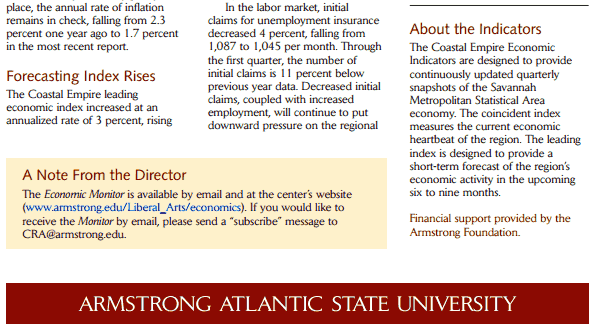
AASU Coastal Empire Economic Monitor Q1

Dr. Toma has published the 2013 Coastal Empire Economic Monitor Quarter 1 report.

Summary: We are treading water in a sluggish stream that is moving in the right direction. Consumer confidence is weak, but tourism is up and so is housing. (In fact, in many areas of Savannah we are in a seller's market!)

Click on the images for enlargement.


Friday, April 26, 2013

Tampa Luxury Retail Market Report

This has been your Tampa Luxury Retail Market Report.


A. Joseph Marshall 
Coldwell Banker Commercial
Commercial Real Estate Advisor 
Savannah, Ga 
912-790-6999

Thursday, April 25, 2013

Healthcare Real Estate: Looking Beyond The Indicators

I don't know who is reading this blog in India, but thank you very much! If you've got investors in Pune who in interested in property over here, give me a call.

Healthcare Real Estate: Looking Beyond The Indicators is such a good article that I am posted some of it here. It was published 10 days ago by Wayne Grohl for The Source blog.
With only a few exceptions, the mood was decidedly up at Thursday’s Healthcare Real Estate Conference in Chicago.  The investors, brokers, tenants, developers and managers who met at the University Club came to hear about strategies and trends in development, management and capital for medical properties ranging from medical office buildings (MOBs) to large healthcare campuses to retail outpatient facilities. 
 Superficially, the first indicator from 2012 was a drop in medical facility construction starts. Usually, when a sector sees a drop in national groundbreaking, it's kind of tough to read the tea leaves as anything other than a negative.
That wasn't the diagnosis at the conference.

On a panel including Shawn Janus of Jones Lang LaSalle's Healthcare practice, the drop in starts was likened to a deception associated with long-term factors finally clearing up. "We saw a decrease due to the capital markets still rebounding, and a SCOTUS ruling on ACA, then an election," said Janus. "With all that behind us we're going to see greater activity. On the acute care side, that has dropped off. Community hospital starts has slowed down. But we're going to see high-acuity activity driven into the outpatient environment. 

On a side note, my colleague Linda agrees with the conference's tone. This field is growing steadily, but now cautiously. She works extensively in healthcare real estate and sold two hospital sites in the last two years. The third, which was to be a community hospital, was indefinitely delayed. 
  •  Acute care: more or less means large hospitals.

  • High acuity: medical interventions for seriously ill people. Typically conducted on inpatients, that is people who stay over night. But the general trend in medicine and the incentives are to take some higher acuity patients and treat them not in hospitals, but in specialized outpatient settings. One classical example of this trend is the dialysis clinic. There was a time that dialysis for kidney patients was conducted primarily inside a hospital: that has changed in a great many places today.

  • Outpatient: a patient not hospitalized overnight.
What he's describing is a trend - several trends, in medical payments, technology and facilities management- that will cause an explosion in non-hospital medical facility utilitization for outpatients. Strip mall spaces, office renovations, all manner of off-campus medical facilities are going to form the demand nationally going forward. Consider it a retailization of medicine.
Read the rest of the article by clicking the link at the top of the page.

A. Joseph Marshall 
Coldwell Banker Commercial
Commercial Real Estate Advisor 
Savannah, Ga 
912-790-6999