Friday, August 16, 2013

What homeowners need to know about avoiding foreclosure

I am reposting this article word for word that I got from Steve Nimmer here at Coldwell Banker Mortgage. (912) 604-3834 NMLS #: 186680.

Even though the recovery is over and people are getting rich in real estate(Flip That House Now! radio ads are playing again) there are plenty of home owners bank borrowers that are still struggling. And for some reason I sense there is a kind of stigma against them now that it is common knowledge that the recession is over.

So, here is Steve's article to help you out.

Since September 2008, the industry has seen some 4.5 million foreclosures completed, according to the June 2013 CoreLogic® National Foreclosure Report. And while those numbers have been coming down, it is still important that borrowers and homeowners understand what they can do to prevent foreclosure.

That means taking action at the first sign of trouble, such as the first time a homeowner makes a late payment or misses a payment altogether.

1. Analyze the cause
Was the payment late because the borrower had an unexpected expense, like a car repair or a medical bill? Or is the problem due to a job loss, disability or serious illness that could affect income for an indefinite period of time? The answers to these questions can help determine the best next steps.

2. Understand the foreclosure timeline
For most mortgages, a payment made one to 14 days late falls within a grace period. Payments 15 to 30 days late incur a late fee, which must be included at the time of payment. After 30 days, missed payments impact the borrower's credit score. Foreclosure procedures usually begin after four missed payments.

3. Optimize cash flow
Regardless of the scenario, it may be helpful for borrowers to revisit their budget and consider trimming extras like eating out, entertainment and other discretionary spending. It may also be necessary to generate additional income through part-time work or a second job.

4. Make a full payment – including late fees
A partial payment is usually credited as a principal reduction, not a regular mortgage payment. It's better to make a full payment, including any late fees, as soon as the money is available.

5. Communicate with their lender
The lender can help determine whether the borrower is eligible for any of several alternatives to foreclosure, such as refinancing or loan modifications. Even if the mortgage amount is more than the home is worth, the lender may be willing to accept a short sale or a deed-in-lieu of foreclosure.

The bottom line
A willingness to step back and assess the financial situation, take positive action to address shortfalls and work with the lender can go a long way toward helping borrowers avoid becoming foreclosure statistics.


Sources:
CoreLogic® National Foreclosure Report, June 2013
Freddie Mac: Alternatives to Foreclosure
7 Steps to Avoid Foreclosure by Tara-Nicholle Nelson, Esq.


A. Joseph Marshall
Coldwell Banker Commercial
Commercial Real Estate Advisor
Savannah, Ga
912-790-6999

Tuesday, June 18, 2013

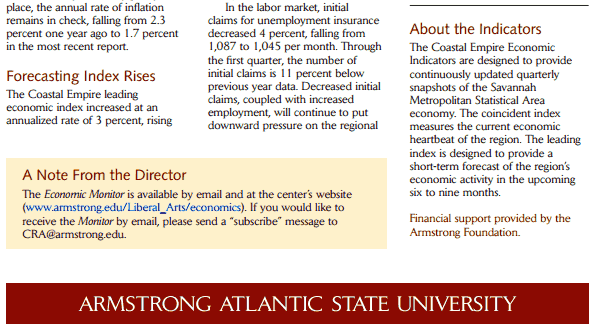
AASU Coastal Empire Economic Monitor Q1

Dr. Toma has published the 2013 Coastal Empire Economic Monitor Quarter 1 report.

Summary: We are treading water in a sluggish stream that is moving in the right direction. Consumer confidence is weak, but tourism is up and so is housing. (In fact, in many areas of Savannah we are in a seller's market!)

Click on the images for enlargement.


Friday, April 26, 2013

Tampa Luxury Retail Market Report

This has been your Tampa Luxury Retail Market Report.


A. Joseph Marshall 
Coldwell Banker Commercial
Commercial Real Estate Advisor 
Savannah, Ga 
912-790-6999

Thursday, April 25, 2013

Healthcare Real Estate: Looking Beyond The Indicators

I don't know who is reading this blog in India, but thank you very much! If you've got investors in Pune who in interested in property over here, give me a call.

Healthcare Real Estate: Looking Beyond The Indicators is such a good article that I am posted some of it here. It was published 10 days ago by Wayne Grohl for The Source blog.
With only a few exceptions, the mood was decidedly up at Thursday’s Healthcare Real Estate Conference in Chicago.  The investors, brokers, tenants, developers and managers who met at the University Club came to hear about strategies and trends in development, management and capital for medical properties ranging from medical office buildings (MOBs) to large healthcare campuses to retail outpatient facilities. 
 Superficially, the first indicator from 2012 was a drop in medical facility construction starts. Usually, when a sector sees a drop in national groundbreaking, it's kind of tough to read the tea leaves as anything other than a negative.
That wasn't the diagnosis at the conference.

On a panel including Shawn Janus of Jones Lang LaSalle's Healthcare practice, the drop in starts was likened to a deception associated with long-term factors finally clearing up. "We saw a decrease due to the capital markets still rebounding, and a SCOTUS ruling on ACA, then an election," said Janus. "With all that behind us we're going to see greater activity. On the acute care side, that has dropped off. Community hospital starts has slowed down. But we're going to see high-acuity activity driven into the outpatient environment. 

On a side note, my colleague Linda agrees with the conference's tone. This field is growing steadily, but now cautiously. She works extensively in healthcare real estate and sold two hospital sites in the last two years. The third, which was to be a community hospital, was indefinitely delayed. 
  •  Acute care: more or less means large hospitals.

  • High acuity: medical interventions for seriously ill people. Typically conducted on inpatients, that is people who stay over night. But the general trend in medicine and the incentives are to take some higher acuity patients and treat them not in hospitals, but in specialized outpatient settings. One classical example of this trend is the dialysis clinic. There was a time that dialysis for kidney patients was conducted primarily inside a hospital: that has changed in a great many places today.

  • Outpatient: a patient not hospitalized overnight.
What he's describing is a trend - several trends, in medical payments, technology and facilities management- that will cause an explosion in non-hospital medical facility utilitization for outpatients. Strip mall spaces, office renovations, all manner of off-campus medical facilities are going to form the demand nationally going forward. Consider it a retailization of medicine.
Read the rest of the article by clicking the link at the top of the page.

A. Joseph Marshall 
Coldwell Banker Commercial
Commercial Real Estate Advisor 
Savannah, Ga 
912-790-6999
Tuesday, April 23, 2013

Why Low Interest Rates Matter to CRE

Last Friday night I went out for drinks with an investment banker, a financial advisor, an accountant and the owner of a remodeling business.

As the evening relaxed (e.g. Booze!), I mentioned I was going to New York in May and June for meetings regarding distressed assets to drum up some business. The banker asked me, and I'll paraphrase, "Don't you think you'll be wasting your time speaking to those people? Don't you think the worst is behind us and bank owned properties are dwindling?"

And I said, "No, I think that this [2009-present] is just Round One."

And the banker said, "I agree!"

Why did we agree? Well, the systemic causes that lead to the recession are still in place: consumer debt, over-leveraged banks and business, and corruption on Wall Street. And now we're betting that sovereign leverage is the way to go. We have been told that pre-crash normalcy is returning because housing prices are increasing, the stock market is reaching new heights, CRE is back, gold prices are down, etc... And we are told that all this is inherent, indigenous... like creativity without a source.

But there is a source: low interest rates. An interest rate is how much you pay to borrow money. Banks don't make money with annualized interest rates of 3.25% or whatever it is today. But we have low interest rates to encourage people to borrow money to buy things. As an example, Americans are buying cars left and right and European manufacturers are depending on us. Did you know that about 80% of vehicle purchases are financed right now?

When you read in the paper that a million dollar property sold to whoever, chances are they did not pay cash, but borrowed most of the money for the acquisition. The low interest rates for CRE debt means more people will risk an investment.

But what happens when interest rates increase? Suddenly that debt costs more even though you may have "locked it in" and less goes to the principal. People may take less risks and buy less property. Small rate increases aren't a problem. Big rate hikes are.

This article explains that "low interest rates are one of the only things supporting commercial real estate prices." The author concludes that

"Cap rates are close to their historic lows for most property classes. At the same time, other commercial real estate fundamentals are still weak. This apparent disconnect- low cap rates and weak fundamentals- has prompted some observers to question the Federal Reserve's low interest rate policy. The concern is that low rates may be boosting commercial real estate prices excessively." 
But on the surface things look great! So let's focus on arguments that the market is nuanced, complex, dynamic, etc...

The banker and I are hedging by betting that our future income will come from the sale of more distressed properties coming to market as the rates increase. And we're both hoping people will have the means to buy. Got an income producing property in sight? Is it a good calculated risk? Jump on it now!


A. Joseph Marshall
Coldwell Banker Commercial
Commercial Real Estate Advisor
Savannah, Ga
912-790-6999